

The idea behind Explora Journeys was never simply to build another fleet of luxury cruise ships. It was to rethink how a ship could feel: less like a traditional ocean liner and more like a contemporary residence at sea, with the horizon always in view.
That ambition has shaped the design of the Explora fleet, bringing together yacht-inspired exterior lines, spacious oceanfront accommodation and interiors influenced by European residential and hospitality design. The result is a distinctive approach to luxury cruising, one that places the experience of being at sea at the center of the journey.
Behind the polished surfaces is a more complex story involving yacht designers, interior specialists, naval architects and the Italian shipbuilding expertise of Fincantieri. Their challenge was to translate the intimacy associated with a private superyacht into ships capable of carrying hundreds of guests across the world’s oceans.
For travelers curious about what makes Explora Journeys different, the architecture offers an illuminating place to begin.


The vision behind the Explora Journeys fleet
A superyacht sensibility on a larger scale
The story begins with a question: how do you create the feeling of a private yacht without sacrificing the variety, space and facilities expected of an ultra-luxury cruise ship?
Explora Journeys turned to British designer and architect Martin Francis to help answer it. Known for his work on some of the world’s most notable yachts, Francis was brought into the design team to shape the fleet’s exterior profile and move it away from the familiar visual language of conventional cruise ships.
His contribution extended to the ships’ outlines and defining features, including the funnel and windscreen. The intention was not to disguise the vessels as small yachts, but to give them a more sculptural, streamlined presence that draws on superyacht design.
That distinction matters. A ship carrying hundreds of guests has different engineering requirements from a privately owned yacht, but it can still borrow from yacht design’s emphasis on proportion, privacy and the relationship between indoor and outdoor spaces.
The result is a recognizable silhouette, complemented by expansive decks and interiors designed to make the ocean a constant part of the experience.
The designers behind the interiors
An exterior establishes the first impression, but a ship’s character is revealed in the spaces guests inhabit every day. Explora Journeys brought together several design studios to develop an interior language that feels contemporary, cosmopolitan and residential rather than overtly nautical.
Among the collaborators are SMC Design, AD Associates and De Jorio Luxury and Yacht Projects. Their contributions span different areas of the ships, from public spaces and restaurants to specialist outdoor environments.
The division of responsibilities is important: the fleet’s identity is not the work of one celebrated architect alone. It emerges from the collaboration between the overall design vision, interior specialists, marine engineers, shipbuilders and the teams responsible for turning drawings into a functioning vessel.
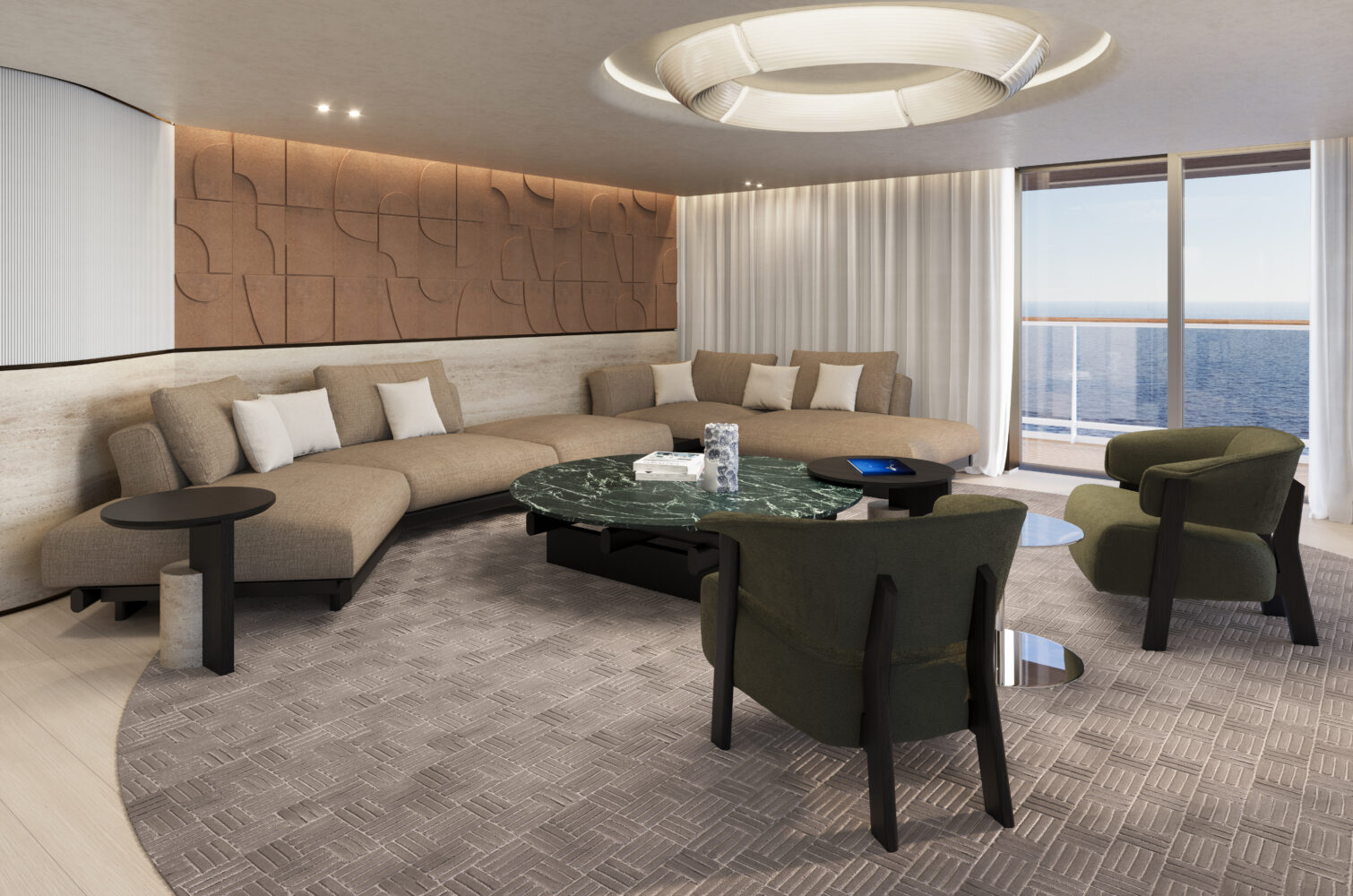
The interiors reflect this collective approach. Muted palettes, carefully chosen furnishings, artwork and considered lighting create a setting that feels closer to a sophisticated city hotel than a traditional cruise ship. Yet the ocean remains the defining feature, visible through windows and from terraces rather than being treated as scenery beyond the walls.
Space as a design philosophy
Suites designed around the view
The most telling architectural decision may be the emphasis on oceanfront accommodation. On EXPLORA I and EXPLORA II, all 461 suites, penthouses and residences are oceanfront, with floor-to-ceiling windows and private terraces helping establish a direct connection with the sea.
Rather than making the view an occasional feature, the design makes it part of everyday life. Morning light enters the living space; the coastline becomes a changing backdrop; and the private terrace offers a place to watch the ship approach a new destination without leaving one’s accommodation.
This is a different expression of luxury from sheer ornament. Generous proportions, daylight and the ability to move naturally between interior and exterior spaces can contribute just as much to a feeling of comfort as decorative finishes.
The same philosophy informs the public areas. Lounges, bars and restaurants provide different atmospheres throughout the day, allowing guests to find a quieter corner or a more sociable setting without the ship feeling like one enormous communal room.
The architectural challenge is to make a vessel of substantial size feel intimate. Explora’s design team has approached that challenge through a combination of spatial planning, varied settings and sightlines that keep the sea in view.
The outdoor spaces are part of the experience
On a ship, outdoor space must do more than look attractive in photographs. It has to work with the vessel’s movement, changing weather, circulation routes and the practical demands of life at sea.
Explora’s decks have therefore been conceived as usable living spaces rather than simply places to walk between facilities. Pools, sunbathing areas, bars and terraces give guests several ways to spend time outside, whether the day calls for a swim or simply a long look at the horizon.
One particularly telling example is the Astern Pool and Bar on EXPLORA II, situated towards the stern. Designed by SMC Design, the space emphasizes the view behind the moving ship, making the wake and open water part of the visual experience.
It is a relatively simple idea, but one that illustrates the larger design philosophy: the sea should be experienced from different perspectives, not just admired from a single observation point.
From boutique-hotel interiors to a floating residence
Interiors with a sense of place
The fleet’s interiors draw on European design traditions without relying on overtly themed decoration. Natural materials, art, furniture and lighting are used to create an atmosphere that feels collected rather than formulaic.
De Jorio has worked on several prominent public spaces, including the Lobby Bar and Journeys Lounge, while AD Associates has contributed to restaurant interiors such as Sakura, the Pan-Asian restaurant inspired by the tea-house traditions of Kyoto.
These spaces demonstrate how design can establish a mood without overwhelming it. Sakura’s inspiration is cultural rather than literal: the intention is to evoke an atmosphere, not to recreate a Japanese setting at sea.
Artwork also contributes to the residential feel. Instead of treating corridors and suites as purely functional areas, the design incorporates art into the experience of moving around the ship and spending time in private accommodation.
For guests, the difference is often felt rather than consciously analyzed. A room can feel welcoming because its lighting is comfortable, its furnishings are well proportioned and its layout makes sense. When these decisions work together, luxury becomes less about display and more about ease.
Patricia Urquiola brings a new perspective
The design story has continued to develop as the fleet grows. In January 2026, Explora Journeys announced a collaboration with Spanish-Italian architect and designer Patricia Urquiola on a second Owner’s Residence for EXPLORA III and EXPLORA IV.
Known for her human-centered approach and distinctive use of materials, Urquiola brings a different perspective to the concept of residential luxury at sea. Her Owner’s Residence design is intended to explore the relationship between light, movement, texture and the experience of living on the ocean.
The second Owner’s Residence debuted on EXPLORA III, delivered in July 2026, with the corresponding design planned for EXPLORA IV in 2027. It is a useful example of how the brand can maintain a recognizable design identity while introducing new ideas to individual ships.
For travelers considering an especially spacious suite, this is also a reminder that accommodation categories and layouts can vary across the fleet. Comparing the details of each ship is worthwhile when the private living space is an important part of the holiday.
Built in Italy: where design meets naval engineering
Elegant interiors and sweeping exterior lines are only part of the story. A luxury ship must also satisfy demanding requirements for stability, safety, propulsion, energy use and long-distance operation.
The Explora Journeys fleet is being built by Fincantieri in Italy, bringing the brand’s design ambitions together with one of the country’s major shipbuilding industries. The six-ship program represents an investment of approximately €3.5 billion by MSC Group.
The distinction between design and engineering is especially important here. A yacht-inspired appearance cannot come at the expense of the technical systems required to operate a large ocean-going vessel. Designers and naval engineers must work together from the early stages, considering how exterior forms, public spaces, accommodation, machinery and passenger circulation interact.
Environmental technology is another part of this equation. EXPLORA III, delivered in July 2026, is the first ship in the fleet powered by liquefied natural gas (LNG). The ships also feature shore-power connectivity, allowing them to connect to the local electricity supply in suitably equipped ports and reduce emissions associated with running onboard engines while alongside. The eventual environmental benefits depend on factors including fuel sources, infrastructure and operating conditions.
These developments underline a less visible aspect of luxury ship design: the guest experience depends on complex systems working reliably behind the scenes. Architecture creates the atmosphere, but engineering makes that atmosphere possible at sea.
A fleet that evolves without losing its identity
The original vision is now developing into a six-ship collection. EXPLORA I entered service in 2023, followed by EXPLORA II in 2024. EXPLORA III joined them in 2026, while EXPLORA IV and EXPLORA V are scheduled for 2027, with EXPLORA VI scheduled for 2028.
Each new ship builds on the same broad principles: oceanfront accommodation, generous outdoor areas, contemporary European interiors and a relaxed atmosphere inspired by private-yacht living.
Yet consistency does not require every detail to remain identical. The development of the Owner’s Residence with Patricia Urquiola illustrates how new design ideas can be introduced within an established architectural framework.
For prospective guests, this creates an interesting reason to look beyond the name of the cruise line. The individual ship, its accommodation options, public spaces and planned itinerary all contribute to the experience. Those details are particularly relevant when comparing a Mediterranean voyage with a longer journey through Northern Europe or a sailing that includes the dramatic landscapes of Iceland and Greenland.
Interested in discovering Explora Journeys for yourself? Call us at 888-717-5074 we can help you compare Explora Journeys ships, explore available itineraries and choose a voyage that suits your travel plans.
Book Your Explora Journeys Cruise
Frequently Asked Questions (FAQs)
Q: Who designed the Explora Journeys ships?
A: The fleet’s design brings together several specialists. British yacht designer and architect Martin Francis helped shape the exterior profile, while SMC Design, AD Associates and De Jorio Luxury and Yacht Projects have contributed to different interior and exterior spaces.
Q: Where are Explora Journeys ships built?
A: The ships are being built by Italian shipbuilder Fincantieri as part of MSC Group’s six-ship investment programme.
Q: What makes Explora Journeys’ design different?
A: The ships combine yacht-inspired exterior styling with oceanfront suites, private terraces, contemporary interiors and generous outdoor living spaces. The intention is to create the atmosphere of a sophisticated residence at sea.
Q: Who designed the Owner’s Residence on EXPLORA III?
A: Architect and designer Patricia Urquiola designed a second Owner’s Residence for EXPLORA III and EXPLORA IV, introducing a new interpretation of residential living at sea.
Q: How many ships will Explora Journeys have?
A: The planned fleet comprises six ships. EXPLORA I, EXPLORA II and EXPLORA III are in service as of October 2026, with EXPLORA IV and EXPLORA V scheduled for 2027 and EXPLORA VI for 2028. Delivery schedules can change.
Q: Are all Explora Journeys ships identical?
A: They share a consistent design philosophy, but individual ships can have different layouts, accommodation configurations and features. Check the specifications of the ship you intend to book.
